Showing posts with label Guitar History. Show all posts

Monday, August 8, 2016

HISTORY OF THE GUITAR AND

WHERE IT CAME FROM

Later Guitar-
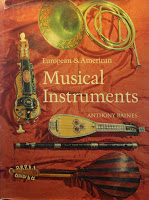


Taken from The book was entitled “European and American Musical Instrument” by Anthony Baines; A studio Book - The Viking Press - New York; 1966; Library of congress catalog card number 66-25611.


Later Guitars


The middle of the 18th century was a quiet era in guitar design, even though ‘Spanish guitars’ were sold in most capitals.  Yet one can see in the proportions of some examples the beginning of changes which were accelerated in the last 20 years of the century.  Average measurements across the body of a full size guitar of the old type are of the older of:  upper part, 8 ¼”, waist 7”, lower part 10”,  By the end of the century the corresponding figures might be 9”, 6 ½”, 11”, thus wider, though narrower in the waist  At this point the great creative period in the guitar’s history may be said to have begun, bring in a host of new features, some of which must now be noticed.


A typical early transitional guitar is by Lamblin (296).  By this time, vaulted backs were no longer made, save sometimes in peasant instruments.  The interior, previously lined only with paper, had sooden derfing strips or rows of separated triangular blocks.  Soundholes are usually left vacant.  Pages of Cadiz had already introduced fan-barring of the lower part of the belly before 1800 for acoustical gain.  The change from double courses to six single strings commenced also before 1800, first probably not in spain but somewhere along a paris-Naples axis passing through Marseilles.  From Naples a guitar in the Claudius Collection, Copenhagen (172), with the label of Antonio Vinaccia, 1784 (318), the single courses are already attached to a pin bridge-a device taken from harp practice.  The lyre-guitars also seem to have been single-strung from the first.  (The six single strings of the guitar have been normally three of gut and three of overspun silk.)


Alternative shapes of the head enter after 1800, including a figure-of-eight from (298), also machine heads from c. 1802 though not common until later.  The guitars played by celebrated musicians like Weber, Schubert, Paganini and Berloiz would have been of the later transitional types with pin bridge, etc, as illustrated by an example by Grobert (298, 299) signed with the names of the last two of these musicians.  The fingerboards are still mostly of the old type, flush with the belly and occasionally still fretted with gut.  The extended fingerboard came in gradually after 1800 and is uncommon before 1830 save in advanced models like those of Louis Panormo of London, who had been introduced by the soloist Ferando Sor, c. 1809, to the latest Spanish models of the time.  Two Panormo examples (302, 304) show this maker’s own development of the  Spanish Model and the enormous progress made in advanced guitar design by 1830.  Further enlargements of the body, especially in the lower parts, relocation of the bridge to the centre point of the lower bouts, and reduction of ornaments, took place in the 20 years, resulting in the mid-century models of Antonio Torres (305, 306), often cited a the creator of the modern Spanish guitar, and of other forward-looking luthiers like Martin of New York (308), Torres developed the Spanish tied bridge, rejecting the pin bridge which had made inroads into Spain as it had elsewhere.  For a flamenco guitar the old peg head had been preferred to machines, for its relative lightness.


Besides these developments, guitars of less advanced models continued to be made up to the end of the century, particularly high decorated ‘ladies models’ (310).  Also there have been innumerable variants forms, the most successful being that which is known in Germany as a Wappengitarre, ‘shield guitar’ (303), evolved in Vienna about 1800 on the premise that the upper swell of the body contributes little to the tone and might as well be omitted, or rather, for sake of appearance, be reduced to points.  The model was copied to some extent in other countries and is in manufacture still.  Other basically round outlines include cittern-like (311), a crescent forms (319) and many others.  They are identified as guitars by their six strings (but in Russia often seven) and their guitar string length of around 25”.  There are also early nineteenth-century lyre-guitars which the arms reduced to squared-off stumps.  An american ‘harp-guitar’ dating from c. 1834 and still used recently by some soloist has an oval body with a long hollow prolongation which reaches to the floor (324).




Do you like my posts?  Please share with your friends
to keep me motivated and making posts.
Love and Peace and keep Rocking!


A Sun Burst Lawsuit Gibson 330
My latest Favorite Guitar
A Sun Burst Lawsuit Gibson 335
(My Blog post for this Guitar)


Thursday, August 4, 2016

HISTORY OF THE GUITAR AND

WHERE IT CAME FROM

-with-

Biography & Partial Bibliography of

Author Anthony Baines


Apparently, I was wrongly told that the Guitar was an American invention.  Maybe in it’s current rendition, that broad statement is somewhat correct, you be the judge.  


I have wanted to know the story behind the instrument that I have loved my whole life.  After a life long search for that that history I never have been satisfied. Until!

Front and Rear Dust Book Cover

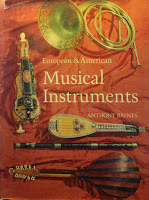
I was at an estate sale in West Hollywood, California while on vacation, and found a book that has satisfied my curiosity about the modern guitar’s parentage.  It would seem that in 1972 Sally and Layce gave Facques a book for his Birthday. The book was entitled “European and American Musical Instrument” by Anthony Baines; A studio Book - The Viking Press - New York; 1966; Library of congress catalog card number 66-25611.


Short Biography of Anthony Baines:  Anthony Cuthbert Baines (1912–1997) was an English organologist who produced a wide variety of works on the history of musical instruments, and was a founding member of the Galpin Society. He attended Westminster School and then read for a degree in Chemistry at Christ Church, Oxford. He subsequently won a scholarship to the Royal College of Music as a bassoon player, and went on to perform with the London Philharmonic Orchestra.


Partial Bibliography:  Brass instruments: their history and development (reprinted 1993);

Woodwind Instruments and Their History (reprinted 1991); European and American musical instruments (1983); Musical instruments through the ages (Pelican, 1961) & Bagpipes Pitt Rivers Museum, Univ. of Oxford, 3rd edition, 1995 147 pages with plates.


If you are a serious study of musical instruments, books by Anthony Baines would be a great addition to your library or a great source if checked out of a library.  As follows is an excerpt from the book, mentioned above, relating to my quest for knowledge about guitars. Enjoy!


HISTORY OF THE GUITAR AND WHERE IT CAME FROM


(Pages 48-49)

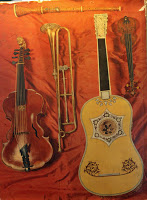
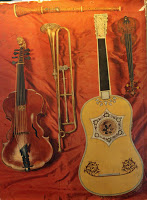
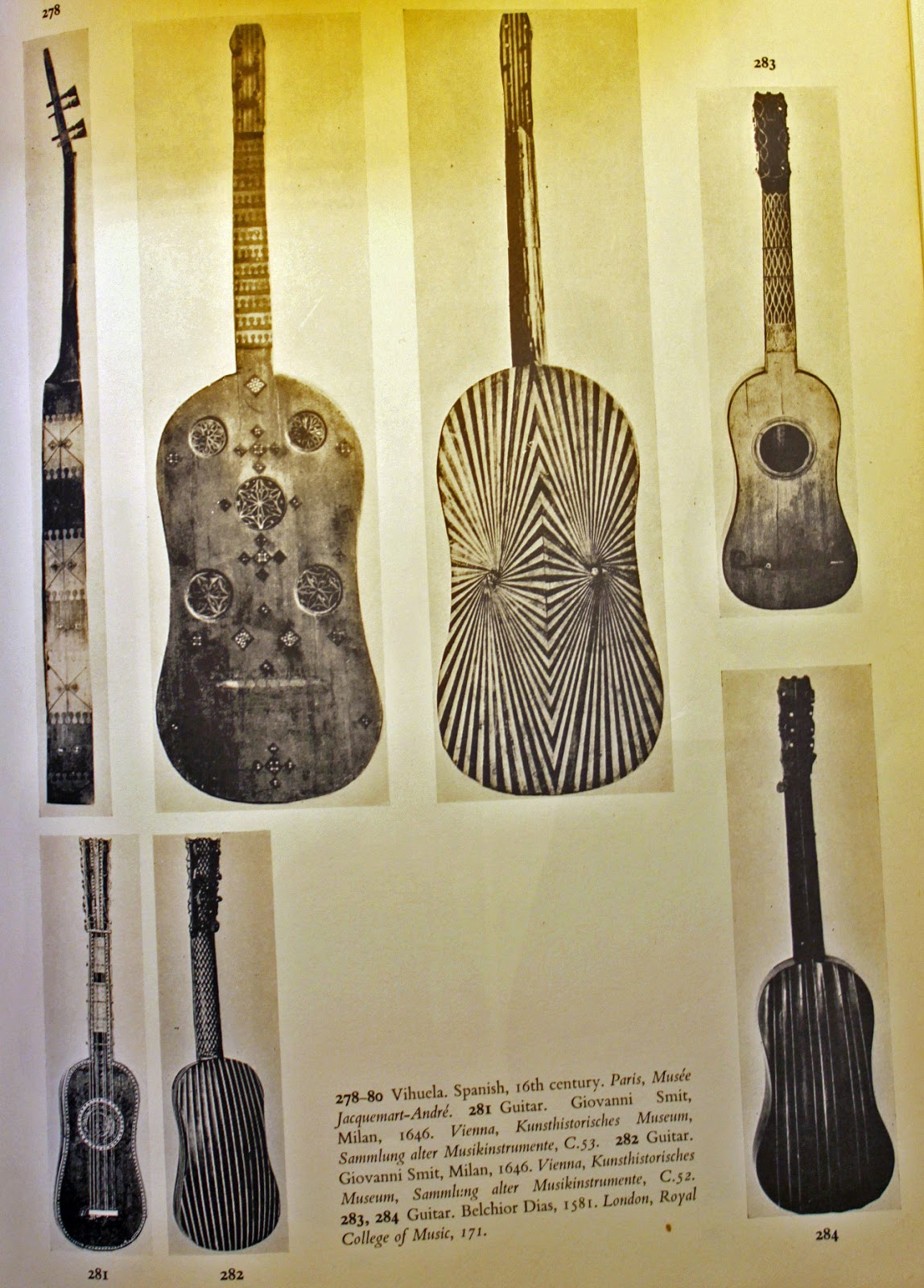
The first guitar to figure importantly in musical history is the Spanish Vihuela, which held a place in courtly music during the later 15th-century and the 16th somewhat corresponding with the lute in other countries.  Only one of these guitars has been identified (Illus.278-280), a large, shallow-bodied guitar with a curious disposition of sound holes matched in contemporary drawing of the instrument.  


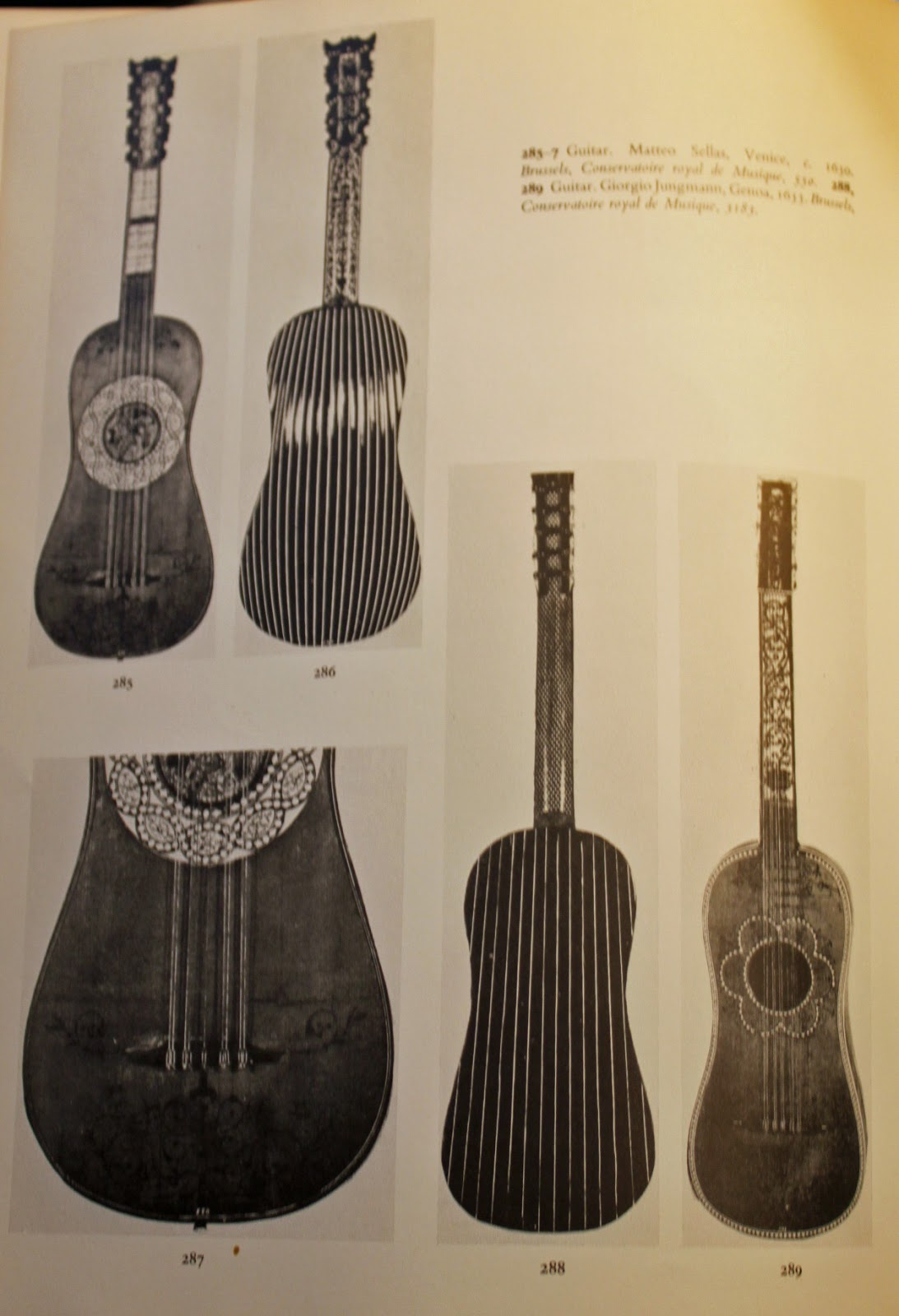
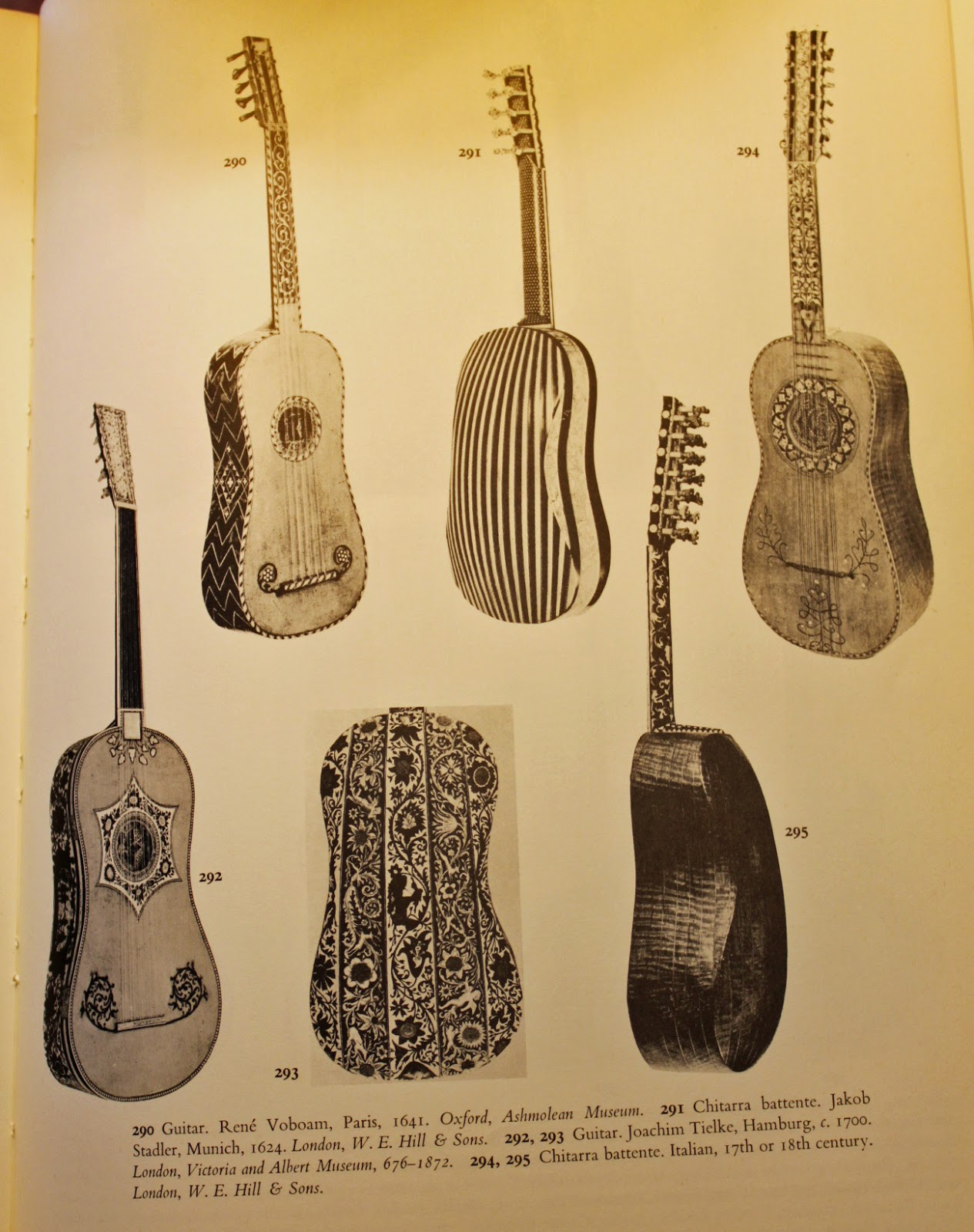
The ordinary guitar of the same period of early Spanish guitarras are somewhat different by having a rather lower musical status and a smaller size with fewer courses.  Descendant of it abound in the Peninsula a regional forms like the small Tiple guitar or the Machete (275) with four or fives strings not unlike the ukulele and others built in shapes recalling medieval instruments (277) and in the form of a fish (276), Most of them now with a single courses.  The small 16th-century instrument is shown in French drawings from 1550 with four courses, of which the first is single, and with a body shape similar to that of subsequent guitars up to the 18th-century looking narrow-bodied with an unobtrusive waist, rose in belly and gut frets.  The head is flat as later or outside Spain. It may have a mandore-like pegbox.  Early Spanish specimens seem very scarce.  A guitar with the date of 1581 and labled of an otherwise obscure Lisbon marker (283, 284), may be genuine, though somewhat altered through restorations.  Two small 17-century Italian guitars at Vienna (281, 282). On of them still in four-course condition, similarly have vaulted backs moulded from ribs with an appearance of deep fluting.  This construction,  which makers may have felt to be a particularly strong one, is common up to the beginning of the 18-century in Italy, France and Germany.  The sides of such instruments are usually also made from ribs matching the colours and decoration of the back.  Almost invariably the belly wood is continued a little way up the face of the neck before abutting the fingerboard proper, presumably as a strength member rather like the deck of a ship, for though the guitar is with honor one of the most perfect of instruments it tends to be structurally not the strongest.  The guitar through the 17th-century in Italy and France seems to have been an instrument-by no means the last-which many sought to possess as a handsome object not necessarily to be be played and is hard to learn.  Ornate decorations include sunk roses intricately constructed from cylinders and tiered elements in ivory and parchment; extravagant twirled moustaches to the bridge; finely shaped heads surmounting richly inlaid neck and fingerboard (285-9).  Five courses are unusual, though sometimes in the 18th-century there are six(290).  In Italy, after the generation of Sellas, some large guitars survive from the workshop of Stradivari (ashmolean Museum and Paris Conservatoire).  Many instruments were given fixed frets during the 18th-century and in the 19th-large numbers were converted into six-string guitars.


Wire-strung guitars.   Metal strings have been used on the guitar in certain forms from the 17th-century up today, a traditional form still is use being Portuguese ‘Braga guitar’ (Viola bragueza), often still built with the old type of blush fingerboard.  The wire strings are said to be advantageous when the instrument is used for accompaniment for long hours in hot sun.  Best-known of earlier types is an italian form of the 17th-century onwards which historians term chitara batente (signifying a guitar strummed with a plectrum)-a term which, according to the late Professor Kinsky, was gathered from Tuscan vernacular in the last century by collector Paul de Wit.  In this species, in which the body normally has the vaulted form of back, the belly is bent inwards at the bridge level as in the Neapolitan mandolin and the wire strings are attached to hitch pins at the base (294-295).  A protector plate may be fixed to the belly.  The neck has fixed frets and the head may contain as many a 15 pegs, since any number of the five courses may be tripled courses.  Italian speciments are rarely signed; signed examples are generally conversions from ordinary guitars, though not invariably (291).


Check back to read the next blog that talks about the Later Guitars of the 18th-Century,

Pages Related to Illustration Numbers.