Lawsuit Guitars, Gibson ES-330, 335, 345 and 355 Reproductions by Mann & Ibanez,
Alan’s Mann-
A702T Guitar
-Alan Arnell
In 2014, I fulfilled a years old dream of owning a Gibson ES-355 TD Guitar, well sort of.
When, I was just a small lad my best friend Ron and I one day decided to explore his parent’s storage closet. In the back on top of a stack of old-dusty cardboard boxes was an acoustic guitar. It was black and brown and was in a very bad state of disrepair. I can not remeber the extent of the damage other than the guitar was not playable.
Finding that old guitar was the inspiration for Ron and I to learn and play guitars, that has continued until this day.
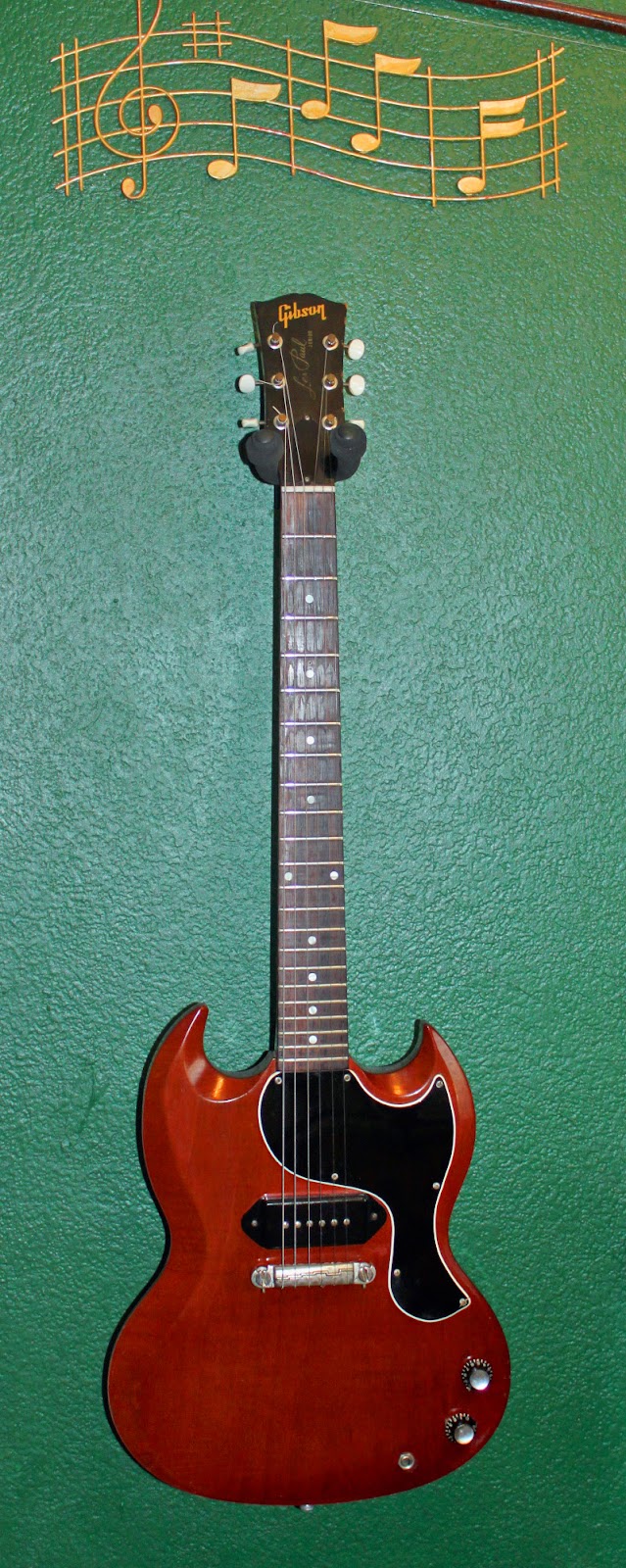
Both Ron and I bugged our parents for guitars. Ron was to receive a guitar first and I was to later be given my cherry red Gibson SG Les Paul Junior. Link to a post about my ‘First Guitar.”
 |
| Eric Clapton |
The guitar Ron was given was a brand new Gibson ES-330 or 335 TD. At the time, I for one, was not crazy about the guitar. What did I know then, nothing, I was just a kid. The ES-335 guitar of the day was not depicted in pictures of rock and roll bands that I was looking at on album covers at the time. My rock heroes of Jimmy Page, Duane Allman , Eric Clapton, Joe Perry and Gary Moore were playing Gibson Les Paul Customs. The Les Paul Custom Guitar was the top of the pyramid in my mind's eye.
Time progressed and I changed my mind about the Spanish Electric 335 guitar. I wanted a guitar that was a
semi-hollow guitar that played louder, when not plugged into an amp, than my solid-body
guitars but not as loud as my acoustic guitar. Old memories
faded back to me and I decided I just had to have a Gibson 335.
semi-hollow guitar that played louder, when not plugged into an amp, than my solid-body
guitars but not as loud as my acoustic guitar. Old memories
faded back to me and I decided I just had to have a Gibson 335.
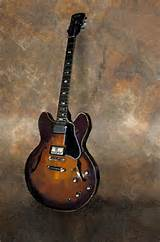 |
| Gibson ES-335 |
The 330, 335 ar 355 Gibson Guitars were just out of my price range. I found the thin line Gibsons were generally priced from $1,800 to $40,000 both new and preowned. Being a family man with hobby playing guitar skills, I could not justify paying that amount of money for a guitar. Then I discovered lawsuit guitars.
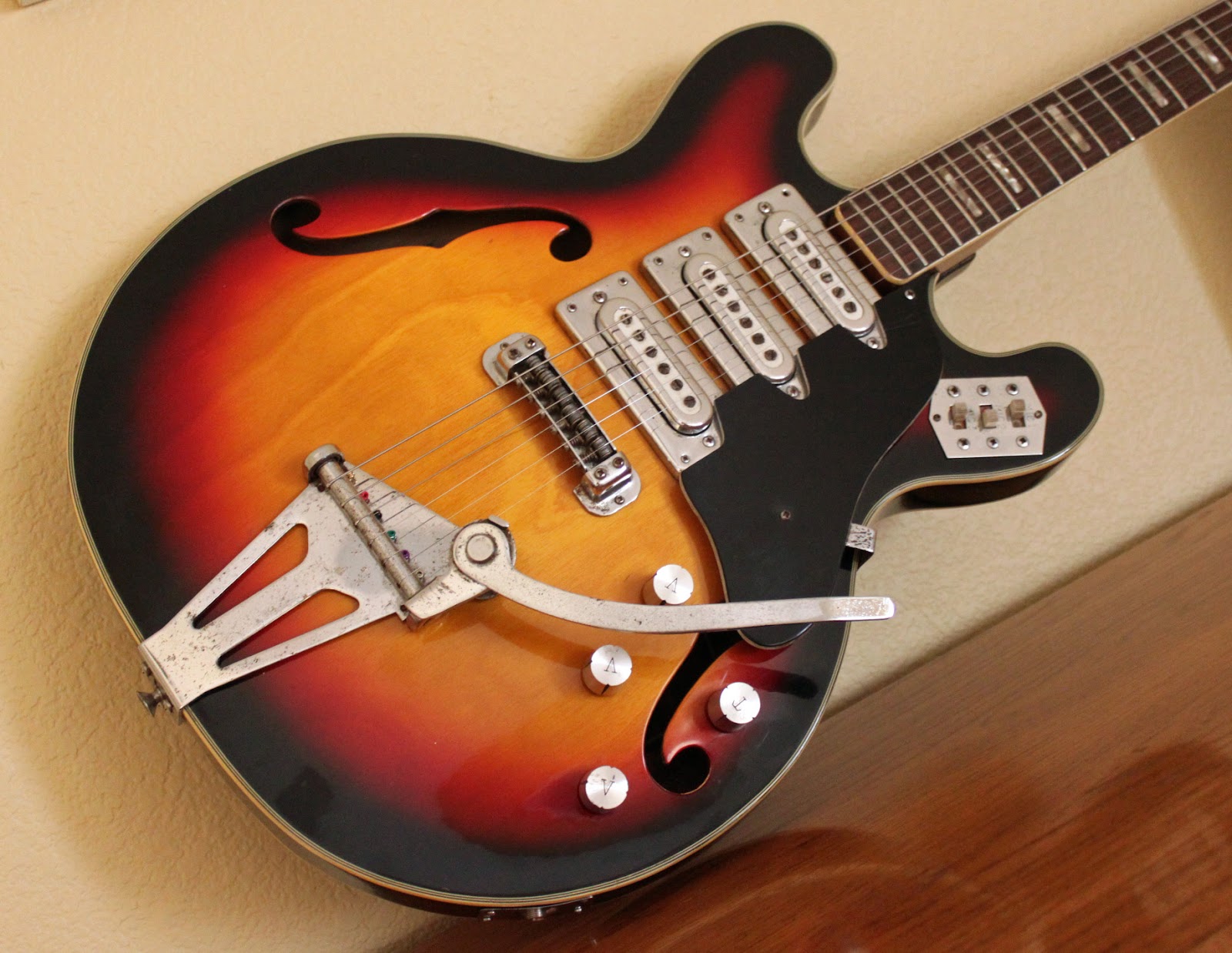
 I made my mind up to buy a 335 lawsuit guitar with the following conditions. I always have wanted a guitar with a vibrato unit also called a whammy bar or tremolo bar. (The use of the word "tremolo" is misplaced. Tremolo refers to volume modulation, whereas vibrato refers to the raising and lowering or raising pitch by changing the tension or length of the strings) I wanted a blond colored guitar that I saw either George or John play. The blond guitar proved hard to find for sale. The lawsuit guitar makers may not have made a blond color, like Gibson? The vibrato option was rare but not impossible to find. I relented and bought my second choice which was a sun burst colored guitar with a vibrato bar. A guitar just like Ron had all those many years ago, minus the vibrato bar.
After a three month search on eBay, I found the guitar I was looking for in the price range ($300) I was willing to spend. The guitar was advertised as a 70’s MIJ/Japanese 335 hollow-body-archtop, 3-single pickup guitar.
When I received the guitar, I was was unable to play my, new to me, guitar, because two strings were missing. I.quickly took it to Guitar Center
for new strings and a tune-up.
for new strings and a tune-up.
 |
| Alan's Mann Guitar |
The Guitar is great to play. The strings are a comfortable distance from the neck. There is no neck up and down play and there was no string buzzing in the higher frets.
Being a semi-hollow guitar the sound it produced was different than what I was used to, but I soon got over that problem. The thin semi-hollow body is louder than a solid body guitar, but the semi-hollow lacks the acoustic guitar’s fullness of sound. At first, I could hear a sympathy buzzing during play. I deciphered that the pickguard screws were loose and once tightened the buzzing went away.
I enjoy the jazzy sound the guitar has when plugged into an amplifier. However, only two of the 3 pickups work. I looked inside of the guitar and could see the wires have cracked insulation. Afraid of causing more problems, I have ceased playing the guitar plugged into my amp.
 I am not complaining, when I say that most of the
metal parts on the guitar are pitted. I knew this before I purchased the guitar. The pitting does nothing to the overall pleasing sound the guitar produces. The pitting is to be expected for a guitar 40 years old. Truth be told, the guitar, even brand new, was marketed as a less expensive alternative to a Gibson. The guitar plays almost as good as a real Gibson, however the hardware is where the Japanese makers reduced the price of the guitar.
 There are no markings on the guitar that tell me the name of its manufacture or serial or model numbers. The only marking is a inlay design on the “open book” head that resembles the Gibson inlay design, except my guitar’s inlay is smaller and the rectangle part of the inlay design is horizontal rather than angled. The only marking on the guitar is the word Japan, stamped on the neck bolt cover plate. I tell people that my guitar is a Mann A702T because there is no manufacturer's name on the guitar. I feel the need to call it something. I do not think it is really a Mann, because of lack of a name inlay in the head. I bought the guitar from a New Jersey guitar shop owner which is 3,000 miles from
where the Mann Co, wholesaled thier guitars. There
were many guitar distributors selling the the same guitars under
different names or in the case of my guitar no name.
So what is a Lawsuit Guitar?
 It must be said that there is a great deal of misconceptions and false information about lawsuit guitars being passed around among gutiar people. I will explain in more detail later.
The so called lawsuit era was between the late 1970’s early 1980’s. During that time guitar manufacturers In Japan began to copy or replicate Gibson and Fenders Guitar’s from the 1950’s. It appears that the Japanese guitar makers literally took vintage guitars and copied them. Some people say, the Japanese manufacturers copied the American made guitars too closely. The copied guitars were sold originally only in Japan, but eventually made their way to the the US market. Several companies started copying the American 50’s designs at the same time. What was maybe good for the consumer and bad for Gibson and Fender was the fact that the copies were really good playing guitars. Ibanez, Greco, Tokai, Fernandes and Burny were the biggest and most well known makers of lawsuit guitars.
 The Japanese made lawsuit guitars had a very accurate feel, quality of wood and construction methods that stayed true 1950’s originals. The lawsuit guitar makers purchased the same good-quality parts, such as the tuners and pickups, for their guitars. If you were that guy, you could have put a Gibson or Fender logo on many of the lawsuit guitars and easily fooled the average to better than average guitar aficionado.
The goal of Ibanez, et cetera, was to reproduce the best American made guitars from the golden era, of the 50’s and make them affordable. The early days of reproducing were arguable, for the money, the best guitars ever made. The playability, attention to detail, and tone of the guitars were extremely good.
Sadly, at that time American guitar makers, like the auto
market of the same era, were cost cutting to make bigger profits thus producing
a poorer quality product than in years past.
Sadly, at that time American guitar makers, like the auto
market of the same era, were cost cutting to make bigger profits thus producing
a poorer quality product than in years past.
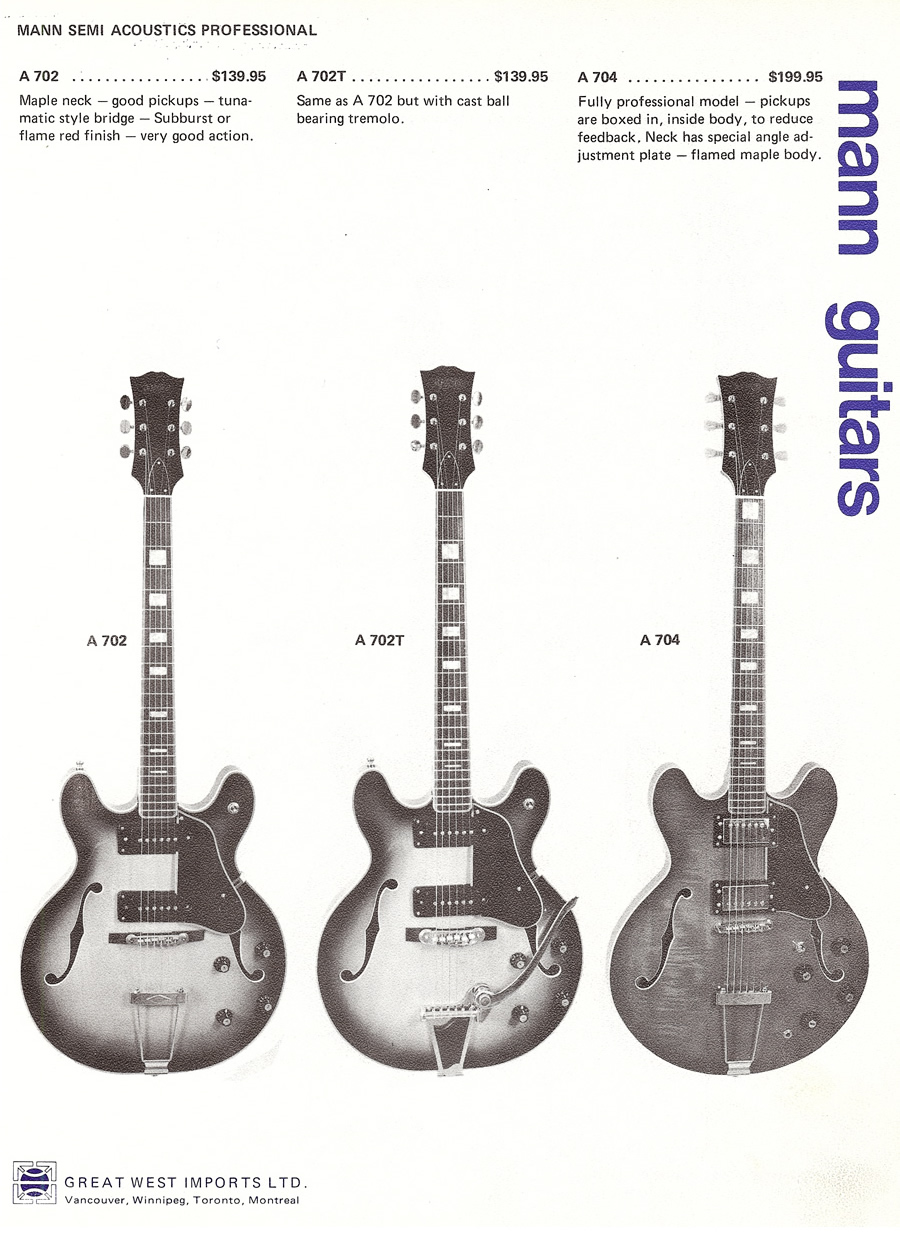
Most of the early reproduced Gibson and Fender guitars made in Japan were sold to the home country consumer. The first venture into North America was by the Mann Company. Mann Guitars were only sold in Canada by Great West Imports in Vancouver. MANN sold guitars from 1971 to 1985. The company is no longer in business.
The first generation Mann guitars from 1971 to 1976 were made in Japan at the Fuji-Gen Gakki factory, the same as Ibanez and many other brands. During the early 70’s the factory made enough inventory to last into the late 1970s. The second generation of Mann guitars ranged from 1980 to 1985 and were made in Korea.
The way to tell if a Mann guitar was made in Japan is by where the neck connects to the guitar body. If the neck corners are slightly rounded, the guitar is Japanese made. If the corners are square, it was made by another in Korea

MANN guitars were almost identical to the Ibanez models of the same era. This is the era of the lawsuit guitars or technically, pre-lawsuit, where they were direct copies including the headstock shape and design. After the lawsuit by Gibson Hoshino Gakki introduced Ibanez models that were not copies of the Gibson or Fender designs such as the Iceman and the Ibanez Roadstar.
Why did Mann and Other Companies Jump into the North American Guitar Market and Why Were They Successful?
When Rock N Roll became mainstream in the 1960s guitars became an important symbol of American popular culture. Every guy and gal wanted to play guitar. Until this point in time the guitar was considered a passing fancy. The Beatles were given a pass by a record company in the UK, because the company believed that guitar playing bands were on the way out of popularity. The beatles of course proved that assumption to not be true. In truth the Beatles set the standard and modus operandi for most of all bands to come after the Beatles. The Beatle method still works and holds true today, 45 years later.
 The American youth market prompted corporations to venture into the market with a proven product. During this time, corporate owners of Gibson and Fender allowed their products to become, as I stated before, mediocre. That sad fact along with a lower cost helped youthful consumers to flock to and buy the new guitars from Japan.
Of course many of the first Japanese guitars to reach western markets were cheap, entry-level models designed to capture the burgeoning guitar market. However, where it all started in Japan there was a blooming appreciation of American Culture. The Japanese youth wanted the cool and great playing original Gibsons and Fenders Guitars. But as you can imagine the Gibsons and Fenders were hard to find and
prohibitively expensive.
prohibitively expensive.
 With that "want and need" by consumers unfulfilled, of course, someone had to step in and exploit the void in the market place for the yearning of American guitars. Fuji-Gen Gakki and Tokai Gakki began creating fairly faithful replicas of the vintage-style Les Pauls, Strats and Telecasters that the marketplace had come to admire.
In 1978 Hoshino abandoned the idea of copying popular American Guitar models and started manufacturing guitars from their own designs. Ibanez began changing the shape of their headstock in 1977 to the current "tulip" shape and the era of the "Lawsuit" guitars was over.
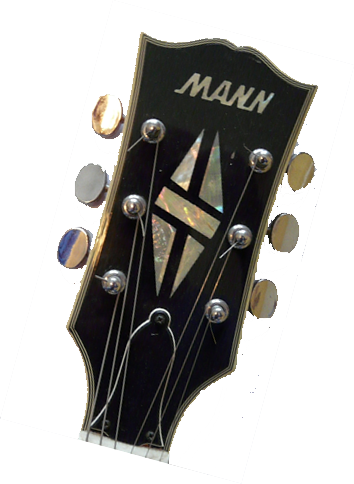 Pre-lawsuit Ibanez guitars with the "open book" headstock are today sought after more than the post-lawsuit guitars. Guitar collectors are getting interested in the lawsuit vintage guitars because of the internet exposure they get. Do they have a better than average vintage value? Maybe. However, the copied guitars compared with the originals will never be the same because for one reason the lower initial price of the guitars. I hope and many believe the lawsuit guitars will increase in price in the coming years.
Logo of the 70’s

Logo of the ‘80’s

History of the Thinline Archtop Semi-Acoustic Electric Guitar
 The world's first commercial thinline archtop semi-acoustic electric guitar was the Gibson ES-335. Gibson first sold the ES (Electric Spanish) series in 1958, it was neither hollow or solid. Gibson made the guitar by placing a solid maple wooden block through the center of the guitar’s body. The side "wings" are hollow, and the top had two violin-style F-holes over the hollow chambers.
Before the ES-335, Gibson mainly produced only hollow-body guitars. Those guitars were well know known for their feedback when the amp was turned to 10. To satisfy the highly amplified customer who wanted to play at full volume, Gibson produced their first solid-body. The new solid-body guitar was named the Gibson Les Paul.
 The ES-335 was Gibson’s beginning attempt to produce a Guitar with a warmer tone than the solid body designs. The goal was to have a hollow-body guitar that was feedback free like the solid-body designs.
The ES-335 were a compromise of earlier designs. This compromise produced a very flexible playing guitar. The wide range of play made the ES-335's extremely popularity with blues, jazz, and rock musicians. With a basic price of $267.50 the ES-335 became a great success. The ES-335’s never failing sales figures has allowed the design to be in continuous
production since 1958 with only visible change being
to the markers on neck. The early models ES-335
had dots (hence named "dot neck") and later
models had blocks.
production since 1958 with only visible change being
to the markers on neck. The early models ES-335
had dots (hence named "dot neck") and later
models had blocks.
Model Variations: (Most Common)

1960 Gibson ES-355 TD 1965 Gibson ES-345 TD 1965 Gibson ES-335 Stereo
- ES-345: The ES-345 was first produced in 1958 as upscale version of ES-335. with a featured a multi-position "Varitone" switch.
- ES-355: The ES-355TD (Thinline semi-hollow, Double pickups) was at the top of Gibson's range of thinline semi-acoustic guitars. It was manufactured from 1958 until 1982, Rather than the rosewood fretboard on a 335 or 345, both variations of the 355 have an ebony fingerboard for a 'smoother' sound. The ES-355 was available with a Vibrola vibrato unit or a Bigsby vibrato tailpiece. It was also available with a stereo output and Varitone tone filter circuitry. When fitted with the optional stereo wiring and Varitone, the model was known as the ES-355TD-SV.
 |
| Alex Lifeson of Rush playing an ES-355 |
- ES-330 TD: The ES-330 TD is a little different from the ES-335. The 330’s neck attaches at the 15th fret whereas the 335’s attaches at the 19th. The 330 is a thinline guitar that is neither a two thirds or a solid body guitar. It is a totally hollow-body. Gibson finally was able to design a hollow-body guitar without feedback issues with the 330. Therefor, the piece of feedback deadening wood is omitted from the body of the guitar. The 330 has dual cutaway pickups.
 |
| Gibson Cherry-Dot SE-330-TD |
Final Thoughts;

After all that, do I like my Mann A702T guitar? You bet. Would I like to have a Gibson ES-355? Hell yes! Gibson Guitars are often imitated but never totally duplicated. And why? Quality, craftsmanship, playability, mystique and the mystical musical qualities of the Gibson Guitar.

If you have to have the best or are a professional guitar player, by all means you need a Gibson. If you are like me a hobby guitar player and also a devout penny pincher you will be more than happy with a pre and post lawsuit guitar. I know I am!
For references I used my general knowledge and the following web pages:
Mann Guitars
lawsuit info short
Lawsuit info long
Epiphone Casino/Beatles
Gibson 355 info/History
Vibrato unit